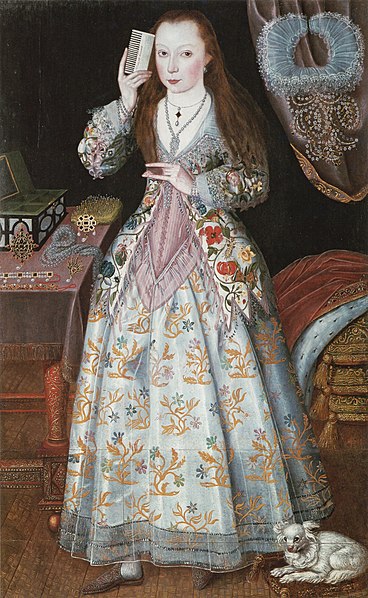
Today I would like to share with you some nice hairstyles that I tried recently. It is easier for me to remind myself that I am learning to become a lady when I change some little things about my appearance. I started to wear only skirts and it's nice to wear heir differently, too (as opposed to same old ponytail or ). Today I tried my version of the fuller ponytail and in recent days I've tried the french braid, braided headband and "split, knot, twist and pin". All these hairstyles are so easy that you can do them yourself but it doesn't hurt to ask somebody if you did it right. But the greatest hair success for me so far has been with the sock bun. However, I didn't cut the sock, I just twisted it around the hair and pulled one end into the other to fasten it. The sock didn't fall out because the hair was holding it together and I fastened it with some pins, too.
It is very easy and looks so elegant and polished. I would like to learn more hairstyles like this even though I am trying to also think about hairstyles to put under a hat in winter.
Today I realized that the way to becoming a lady will be
more fun for me if I share with the internets what I learn along the
way. There are many things I have to learn in order to become a lady. I
am sure there are things that I cannot see yet. However, some things I
see right now are:
To be more patient.
To learn to dress modestly yet elegant (not like today - I wore a nice
elegant black skirt but with dark leggings and red tennis shoes. Only
after 3 people glanced very strangely at me did I realize it was not the
wisest choice).
To learn to cook and bake decently.
To sit straight and confident.
To always think a little before saying things out loud.
Not to interrupt others unneccessarily. (I think these two involve patience, too)
To learn more nice hairstyles.
To live a balanced life consistent with my beliefs, passions and a calling.
...
I could still write more but it seems to me this list is long enough to
tackle during a 6 month stay abroad. I'll try to post my musings every
day.
EDIT 12.10.14: It seems posting every day is virtually impossible for me.
This is the first of ('hopefully) a series of posts exploring the book small is still beautiful by Joseph Pearce.
Pearce embarks on a journey with us to the thoughts hidden in a book Small is beautiful. This new rendering is both a tribute to E. F. Schumacher and a encouragement to new generation to take over in a fight for a world better suited for humans. Both books begin with a proposal that people have souls - they matter because they are not just matter. Economy therefore should be ordered to an end which is not purely economic because no material gain can substitute for insulted self-respect and impaired freedom.
In the second chapter, Pearce asks important questions regarding our state of affairs in economics. The one which could sum all the others in a concise way, which I also heard on a youth camp last month, is this:
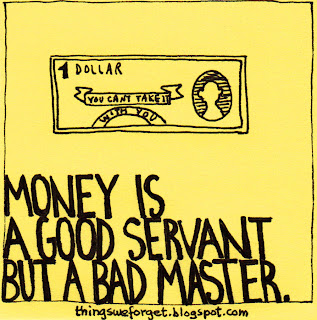
Does money buy happiness?
Answering this question is indeed a large part of the book, proving again and again that blind following of money and growth often corrupts our environment and lessens our freedom. The sense of true value can be obscured by prices which are changed by chance conditions or state experiments with subsidies. Economy needs a goal beyond itself, needs to be limited by values without which human life on this planet wouldn't be possible.
For Schumacher, another problem with the mainstream economic thought is the lack of distinction of goods. The least distinction according to him is that there are primary goods, secondary goods and services and the primary goods are either renewable or non-renewable. GNP (Gross National Product) and the markets ignore these distinctions and therefore cannot distinguish between "healthy" and "sick" growth. If a woman behaves economically and cooks at home, she spends less money for the food and the effect on GNP is lower - therefore what is economic in one context is uneconomic in the other.
Another interesting example from the book: 7.4% GNP of USA in 1990 was caused by costs of cancer, drug abuse and crime. This is surely not a healthy growth.
Concluding the first part of the book are some considerations from UN Report GEO 2000 (Global Environment Outlook) regarding the harmful effect of economic growth on the environment - loss of forests, extinct animals and loss of cultures which used to live in those forests. Also, the efforts to incorporate the poor countries into the world economy by using inappropriate technology have caused massive migration from rural areas to cities.
It is important to note that even for Schumacher, some growth is necessary but it should consist more of the healthy kind and less of the sick kind. I can only add that even for the current Pope Francis, who is a strong critic of contemporary economical reality, the economic growth is necessary but not enough for the growth in justice [EG 204]. Pearce uses a very visual analogy of a human being - until a certain age the growth is good and necessary but after becoming an adult, he can no longer grow taller and only becomes fatter which is a sick kind of growth.
These ideas resonate within me deeply. This part of the book is more like a diagnosis and doesn't show any partial nor holistic solutions to the pressing problems but shows the reality in its spectacular current darkness. Expand or die in economic terms becomes expand and die in ecological sense.
O young Lochinvar is come out of the west, Through all the wide Border his steed was the best; And save his good broadsword he weapons had none, He rode all unarm'd, and he rode all alone. So faithful in love, and so dauntless in war, There never was knight like the young Lochinvar.
He staid not for brake, and he stopp'd not for stone, He swam the Eske river where ford there was none; But ere he alighted at Netherby gate, The bride had consented, the gallant came late: For a laggard in love, and a dastard in war, Was to wed the fair Ellen of brave Lochinvar.
So boldly he enter'd the Netherby Hall, Among bride's-men, and kinsmen, and brothers and all: Then spoke the bride's father, his hand on his sword, (For the poor craven bridegroom said never a word,) "O come ye in peace here, or come ye in war, Or to dance at our bridal, young Lord Lochinvar?"
"I long woo'd your daughter, my suit you denied; -- Love swells like the Solway, but ebbs like its tide -- And now I am come, with this lost love of mine, To lead but one measure, drink one cup of wine. There are maidens in Scotland more lovely by far, That would gladly be bride to the young Lochinvar."
The bride kiss'd the goblet: the knight took it up, He quaff'd off the wine, and he threw down the cup. She look'd down to blush, and she look'd up to sigh, With a smile on her lips and a tear in her eye. He took her soft hand, ere her mother could bar, -- "Now tread we a measure!" said young Lochinvar.
So stately his form, and so lovely her face, That never a hall such a gailiard did grace; While her mother did fret, and her father did fume And the bridegroom stood dangling his bonnet and plume; And the bride-maidens whisper'd, "'twere better by far To have match'd our fair cousin with young Lochinvar."
One touch to her hand, and one word in her ear, When they reach'd the hall-door, and the charger stood near; So light to the croupe the fair lady he swung, So light to the saddle before her he sprung! "She is won! we are gone, over bank, bush, and scaur; They'll have fleet steeds that follow," quoth young Lochinvar.
There was mounting 'mong Graemes of the Netherby clan; Forsters, Fenwicks, and Musgraves, they rode and they ran: There was racing and chasing on Cannobie Lee, But the lost bride of Netherby ne'er did they see. So daring in love, and so dauntless in war, Have ye e'er heard of gallant like young Lochinvar?
This short story goes well with my Christmas preparations. It tells us about a husband and wife who loved each other in a splendid way. The story provides a good way to show how the beauty of the family starts by a great love of the parents. After the whole text there are also a few youtube videos which deal with this tale.
ONE dollar and eighty-seven cents. That was all. And sixty cents of it was in pennies. Pennies saved one and two at a time by bulldozing the grocer and the vegetable man and the butcher until one’s cheeks burned with the silent imputation of parsimony that such close dealing implied. Three times Della counted it. One dollar and eighty-seven cents. And the next day would be Christmas.
There was clearly nothing to do but flop down on the shabby little couch and howl. So Della did it. Which instigates the moral reflection that life is made up of sobs, sniffles, and smiles, with sniffles predominating.
While the mistress of the home is gradually subsiding from the first stage to the second, take a look at the home. A furnished flat at $8 per week. It did not exactly beggar description, but it certainly had that word on the lookout for the mendicancy squad.
In the vestibule below was a letter-box into which no letter would go, and an electric button from which no mortal finger could coax a ring. Also appertaining thereunto was a card bearing the name “Mr. James Dillingham Young.”
The “Dillingham” had been flung to the breeze during a former period of prosperity when its possessor was being paid $30 per week. Now, when the income was shrunk to $20, though, they were thinking seriously of contracting to a modest and unassuming D. But whenever Mr. James Dillingham Young came home and reached his flat above he was called “Jim” and greatly hugged by Mrs. James Dillingham Young, already introduced to you as Della. Which is all very good.
Della finished her cry and attended to her cheeks with the powder rag. She stood by the window and looked out dully at a gray cat walking a gray fence in a gray backyard. Tomorrow would be Christmas Day, and she had only $1.87 with which to buy Jim a present. She had been saving every penny she could for months, with this result. Twenty dollars a week doesn’t go far. Expenses had been greater than she had calculated. They always are. Only $1.87 to buy a present for Jim. Her Jim. Many a happy hour she had spent planning for something nice for him. Something fine and rare and sterling—something just a little bit near to being worthy of the honor of being owned by Jim.
There was a pier glass between the windows of the room. Perhaps you have seen a pier glass in an $8 flat. A very thin and very agile person may, by observing his reflection in a rapid sequence of longitudinal strips, obtain a fairly accurate conception of his looks. Della, being slender, had mastered the art.
Suddenly she whirled from the window and stood before the glass. Her eyes were shining brilliantly, but her face had lost its color within twenty seconds. Rapidly she pulled down her hair and let it fall to its full length.
Now, there were two possessions of the James Dillingham Youngs in which they both took a mighty pride. One was Jim’s gold watch that had been his father’s and his grandfather’s. The other was Della’s hair. Had the queen of Sheba lived in the flat across the airshaft, Della would have let her hair hang out the window some day to dry just to depreciate Her Majesty’s jewels and gifts. Had King Solomon been the janitor, with all his treasures piled up in the basement, Jim would have pulled out his watch every time he passed, just to see him pluck at his beard from envy.
So now Della’s beautiful hair fell about her rippling and shining like a cascade of brown waters. It reached below her knee and made itself almost a garment for her. And then she did it up again nervously and quickly. Once she faltered for a minute and stood still while a tear or two splashed on the worn red carpet.
On went her old brown jacket; on went her old brown hat. With a whirl of skirts and with the brilliant sparkle still in her eyes, she fluttered out the door and down the stairs to the street.
Where she stopped the sign read: “Mme. Sofronie. Hair Goods of All Kinds.” One flight up Della ran, and collected herself, panting. Madame, large, too white, chilly, hardly looked the “Sofronie.”
“Will you buy my hair?” asked Della.
“I buy hair,” said Madame. “Take yer hat off and let’s have a sight at the looks of it.”
Down rippled the brown cascade.
“Twenty dollars,” said Madame, lifting the mass with a practised hand.
“Give it to me quick,” said Della.
Oh, and the next two hours tripped by on rosy wings. Forget the hashed metaphor. She was ransacking the stores for Jim’s present.
She found it at last. It surely had been made for Jim and no one else. There was no other like it in any of the stores, and she had turned all of them inside out. It was a platinum fob chain simple and chaste in design, properly proclaiming its value by substance alone and not by meretricious ornamentation—as all good things should do. It was even worthy of The Watch. As soon as she saw it she knew that it must be Jim’s. It was like him. Quietness and value—the description applied to both. Twenty-one dollars they took from her for it, and she hurried home with the 87 cents. With that chain on his watch Jim might be properly anxious about the time in any company. Grand as the watch was, he sometimes looked at it on the sly on account of the old leather strap that he used in place of a chain.
When Della reached home her intoxication gave way a little to prudence and reason. She got out her curling irons and lighted the gas and went to work repairing the ravages made by generosity added to love. Which is always a tremendous task, dear friends—a mammoth task.
Within forty minutes her head was covered with tiny, close-lying curls that made her look wonderfully like a truant schoolboy. She looked at her reflection in the mirror long, carefully, and critically.
“If Jim doesn’t kill me,” she said to herself, “before he takes a second look at me, he’ll say I look like a Coney Island chorus girl. But what could I do—oh! what could I do with a dollar and eighty-seven cents?”
At 7 o’clock the coffee was made and the frying-pan was on the back of the stove hot and ready to cook the chops.
Jim was never late. Della doubled the fob chain in her hand and sat on the corner of the table near the door that he always entered. Then she heard his step on the stair away down on the first flight, and she turned white for just a moment. She had a habit of saying a little silent prayer about the simplest everyday things, and now she whispered: “Please God, make him think I am still pretty.”
The door opened and Jim stepped in and closed it. He looked thin and very serious. Poor fellow, he was only twenty-two—and to be burdened with a family! He needed a new overcoat and he was without gloves.
Jim stopped inside the door, as immovable as a setter at the scent of quail. His eyes were fixed upon Della, and there was an expression in them that she could not read, and it terrified her. It was not anger, nor surprise, nor disapproval, nor horror, nor any of the sentiments that she had been prepared for. He simply stared at her fixedly with that peculiar expression on his face.
Della wriggled off the table and went for him.
“Jim, darling,” she cried, “don’t look at me that way. I had my hair cut off and sold because I couldn’t have lived through Christmas without giving you a present. It’ll grow out again—you won’t mind, will you? I just had to do it. My hair grows awfully fast. Say ‘Merry Christmas!’ Jim, and let’s be happy. You don’t know what a nice—what a beautiful, nice gift I’ve got for you.”
“You’ve cut off your hair?” asked Jim, laboriously, as if he had not arrived at that patent fact yet even after the hardest mental labor.
“Cut it off and sold it,” said Della. “Don’t you like me just as well, anyhow? I’m me without my hair, ain’t I?”
Jim looked about the room curiously.
“You say your hair is gone?” he said, with an air almost of idiocy.
“You needn’t look for it,” said Della. “It’s sold, I tell you—sold and gone, too. It’s Christmas Eve, boy. Be good to me, for it went for you. Maybe the hairs of my head were numbered,” she went on with sudden serious sweetness, “but nobody could ever count my love for you. Shall I put the chops on, Jim?”
Out of his trance Jim seemed quickly to wake. He enfolded his Della. For ten seconds let us regard with discreet scrutiny some inconsequential object in the other direction. Eight dollars a week or a million a year—what is the difference? A mathematician or a wit would give you the wrong answer. The magi brought valuable gifts, but that was not among them. This dark assertion will be illuminated later on.
Jim drew a package from his overcoat pocket and threw it upon the table.
“Don’t make any mistake, Dell,” he said, “about me. I don’t think there’s anything in the way of a haircut or a shave or a shampoo that could make me like my girl any less. But if you’ll unwrap that package you may see why you had me going a while at first.”
White fingers and nimble tore at the string and paper. And then an ecstatic scream of joy; and then, alas! a quick feminine change to hysterical tears and wails, necessitating the immediate employment of all the comforting powers of the lord of the flat.
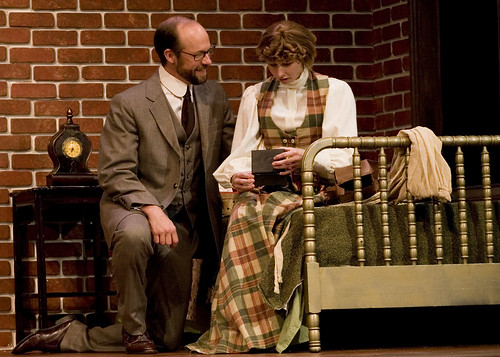
For there lay The Combs—the set of combs, side and back, that Della had worshipped long in a Broadway window. Beautiful combs, pure tortoise shell, with jewelled rims—just the shade to wear in the beautiful vanished hair. They were expensive combs, she knew, and her heart had simply craved and yearned over them without the least hope of possession. And now, they were hers, but the tresses that should have adorned the coveted adornments were gone.
But she hugged them to her bosom, and at length she was able to look up with dim eyes and a smile and say: “My hair grows so fast, Jim!”
And then Della leaped up like a little singed cat and cried, “Oh, oh!”
Jim had not yet seen his beautiful present. She held it out to him eagerly upon her open palm. The dull precious metal seemed to flash with a reflection of her bright and ardent spirit.
“Isn’t it a dandy, Jim? I hunted all over town to find it. You’ll have to look at the time a hundred times a day now. Give me your watch. I want to see how it looks on it.”
Instead of obeying, Jim tumbled down on the couch and put his hands under the back of his head and smiled.
“Dell,” said he, “let’s put our Christmas presents away and keep ’em a while. They’re too nice to use just at present. I sold the watch to get the money to buy your combs. And now suppose you put the chops on.”
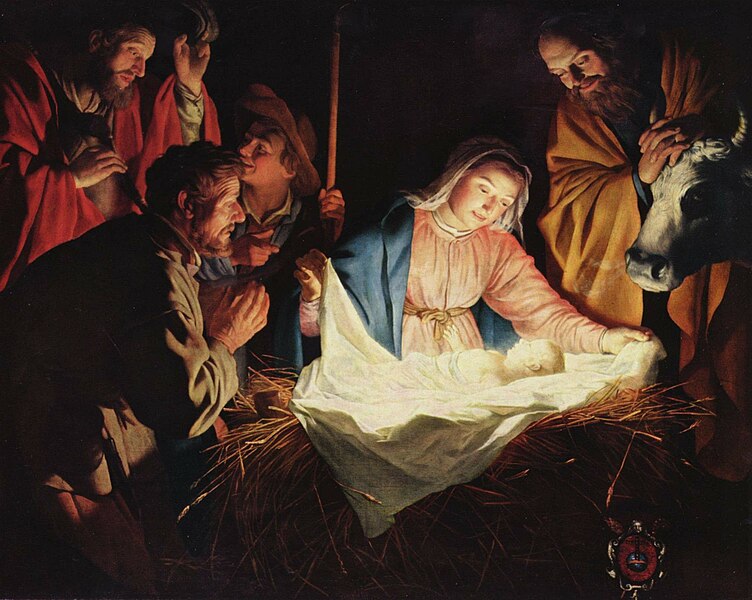
The magi, as you know, were wise men—wonderfully wise men—who brought gifts to the Babe in the manger. They invented the art of giving Christmas presents. Being wise, their gifts were no doubt wise ones, possibly bearing the privilege of exchange in case of duplication. And here I have lamely related to you the uneventful chronicle of two foolish children in a flat who most unwisely sacrificed for each other the greatest treasures of their house. But in a last word to the wise of these days let it be said that of all who give gifts these two were the wisest. Of all who give and receive gifts, such as they are wisest. Everywhere they are wisest. They are the magi.
Let’s go mummy, let’s mummy; let’s to the shops - we need to get a few good things
Nothing for me, honest not a thing for me: just maybe for little Tom; he’s been crying you know, mommy; he’s been crying and we’ll get him a few biscuits and a toy or two for it’s been a week we got him anything
Let’s go mummy, let’s mummy; let’s to the shops - we need to get a few good things
Nothing for me, honest not a thing for me: just for busy Daddy; he’s not shaved in a week if you’ve noticed; we need to get him those throwaway blades and those nice-smelling water in a bottle he puts on his face; he’s too busy and he’s just not been looking smart the past week
Let’s go mummy, let’s mummy; let’s to the shops - we need to get a few good things
Nothing for me, honest not a thing for me; just for you I’ve got three coins saved my sweet mummy who’s always thinking of all of us; maybe a coffee and cake for you while little Tom and I play in the children’s corner; and maybe some shampoo too and lipstick, just for you all with the three coins I’ve got in my pink purse
Let’s go mummy, let’s mummy; let’s to the shops - we need to get a few good things
Nothing for me, honest not a thing for me; but sweet mummy that you are you always think of me and if you insist well, like you might say: “But darling, we haven’t got anything for you” – well, if you insist, I’ve made a list I’ve got it in my pink purse along with the three coins I’ve saved just for you
Raj Arumugam was born (late 1955 edition) in India and moved to Singapore just before he turned six. He lived in Singapore till 1997, a year in the UK, and now lives in Australia. Raj Arumugam is a teacher, poet, writer and businessman. He has experience in the fast food industry, management and in business education and training. Raj Arumugam's poetry, complementing and complemented by images of traditional art from various cultures, is well-known to international audiences through many poetry sites.
Interesting thing to note: the books on his page range from Buddhist topics to Christian.
This poem is to me very playful. It shows the innocent part of consummerist culture. The daughter clearly loves her brother, daddy and mum and shows this by thinking about buying things for them. She knows her mummy will buy something for her too:) The story is funny yet it makes me reflect: Do they really need all those things? Are there other, better ways to build a relationship for their family? Why am I not thinking so much the way this little girl does? The Christmas is coming... I still haven't decided what to give to my family - and this is once or twice a year, not every week.
On the Christmas note, I will probably try to find some Advent (a.k.a. prepare_for_Christmas) poems for the next issue of this blog.